Blab Business
Puebla Manufacturers Eye Role in Mexicos Olinia Electric-Vehicle Supply Chain
Puebla’s automotive and plastics industries are lining up to become part of Mexico’s first home‑grown electric‑vehicle brand, Olinia. Roughly 200 local firms have signaled interest in joining the initiative’s future supply chain, with outreach coordinated by the Puebla chapter of the National Chamber of the Transformation Industry (CANACINTRA). The effort comes as Olinia negotiates a mixed‑investment public‑private partnership that would enable the production of 50,000 electric micro‑vehicles by 2029.
Olinia was unveiled by President Claudia Sheinbaum in October 2024 as Mexico’s inaugural EV brand. The company plans to launch a city‑mobility platform in 2027, priced at MX$150,000 (about US$8,400). The federal government will supply facilities and market access, while private investors are expected to provide capital and operational expertise, according to project director Roberto Capuano.
The Puebla outreach remains exploratory. CANACINTRA Puebla president Carlos Sosa Spínola said the chamber is arranging meetings with Olinia leaders to map the types of supplies that will be required and the conditions under which local industry could be integrated. “The project is still not in a hiring or procurement stage,” Spínola explained, noting that conversations focus on aligning technical and economic expectations before any commercial relationships are established.
Puebla’s automotive ecosystem has long supported global automakers such as Volkswagen and Audi. The region’s certified manufacturing processes cover auto parts, metalworking, and plastics production, and the workforce has been shaped by decades of automotive activity. While the state’s capacity to support large‑scale automotive programs remains strong, the battery and propulsion expertise required for electric vehicles is still emerging.
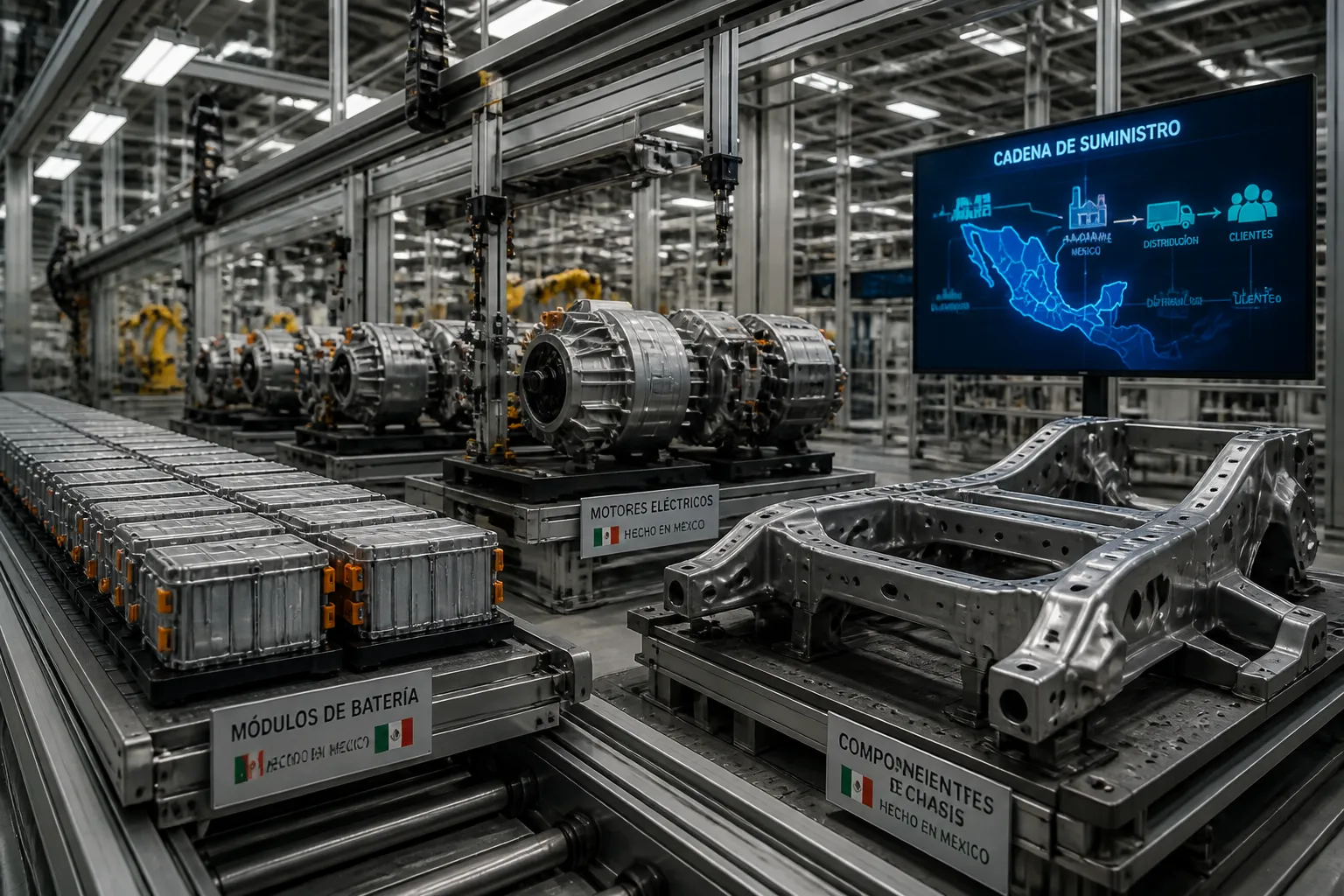
Olinia’s battery strategy centers on lithium‑iron‑phosphate (LFP) cells. Capuano said the battery is still in a prototype stage, but the technological decisions have already been made. The company plans to import cells, manufacture its own battery‑management system, and assemble complete battery packs in a dedicated Mexican facility. The goal is a domestic content rate of 75 % for vehicle components, a target that required an 18‑month assessment of manufacturing capabilities across Mexico.
For Puebla suppliers, the localization strategy presents both opportunity and challenge. While several firms are adapting operations to support electromobility applications, the state lacks a broad base of companies capable of industrial‑scale battery production. Spínola highlighted that information on local battery‑pack manufacturers remains limited, indicating a technological gap that may require external partnerships or long‑term development.
Olinia has attracted interest from more than ten national and international groups. Capuano noted that the project is in the low double‑digits in terms of investor participation and that additional parties are engaged in active conversations. The initiative is still in the industrial‑planning phase, with commercial deliveries expected to begin in summer 2027.
The Puebla outreach reflects a proactive stance by the state’s automotive community, which has positioned itself as a potential contributor to Olinia’s supply chain. Nearly 200 companies have expressed interest in various supply‑chain segments, from component manufacturing to assembly activities. However, no commercial agreements have been signed, and the project remains in the exploratory stage.
As Mexico moves toward a domestic electric‑vehicle industry, the collaboration between Puebla manufacturers and Olinia could shape the region’s role in the emerging market. The next steps will involve detailed technical assessments, supply‑chain integration plans, and the eventual transition from exploration to procurement and production.
The current situation is that Puebla’s automotive and plastics sectors are engaged in preliminary discussions with Olinia, while the project continues to refine its industrial plan and secure investor commitments. No definitive timelines for supplier contracts or production milestones have been announced beyond the projected commercial deliveries in 2027 and the 2029 target for 50,000 vehicles.
Olinia was unveiled by President Claudia Sheinbaum in October 2024 as Mexico’s inaugural EV brand. The company plans to launch a city‑mobility platform in 2027, priced at MX$150,000 (about US$8,400). The federal government will supply facilities and market access, while private investors are expected to provide capital and operational expertise, according to project director Roberto Capuano.
The Puebla outreach remains exploratory. CANACINTRA Puebla president Carlos Sosa Spínola said the chamber is arranging meetings with Olinia leaders to map the types of supplies that will be required and the conditions under which local industry could be integrated. “The project is still not in a hiring or procurement stage,” Spínola explained, noting that conversations focus on aligning technical and economic expectations before any commercial relationships are established.
Puebla’s automotive ecosystem has long supported global automakers such as Volkswagen and Audi. The region’s certified manufacturing processes cover auto parts, metalworking, and plastics production, and the workforce has been shaped by decades of automotive activity. While the state’s capacity to support large‑scale automotive programs remains strong, the battery and propulsion expertise required for electric vehicles is still emerging.
Olinia’s battery strategy centers on lithium‑iron‑phosphate (LFP) cells. Capuano said the battery is still in a prototype stage, but the technological decisions have already been made. The company plans to import cells, manufacture its own battery‑management system, and assemble complete battery packs in a dedicated Mexican facility. The goal is a domestic content rate of 75 % for vehicle components, a target that required an 18‑month assessment of manufacturing capabilities across Mexico.
For Puebla suppliers, the localization strategy presents both opportunity and challenge. While several firms are adapting operations to support electromobility applications, the state lacks a broad base of companies capable of industrial‑scale battery production. Spínola highlighted that information on local battery‑pack manufacturers remains limited, indicating a technological gap that may require external partnerships or long‑term development.
Olinia has attracted interest from more than ten national and international groups. Capuano noted that the project is in the low double‑digits in terms of investor participation and that additional parties are engaged in active conversations. The initiative is still in the industrial‑planning phase, with commercial deliveries expected to begin in summer 2027.
The Puebla outreach reflects a proactive stance by the state’s automotive community, which has positioned itself as a potential contributor to Olinia’s supply chain. Nearly 200 companies have expressed interest in various supply‑chain segments, from component manufacturing to assembly activities. However, no commercial agreements have been signed, and the project remains in the exploratory stage.
As Mexico moves toward a domestic electric‑vehicle industry, the collaboration between Puebla manufacturers and Olinia could shape the region’s role in the emerging market. The next steps will involve detailed technical assessments, supply‑chain integration plans, and the eventual transition from exploration to procurement and production.
The current situation is that Puebla’s automotive and plastics sectors are engaged in preliminary discussions with Olinia, while the project continues to refine its industrial plan and secure investor commitments. No definitive timelines for supplier contracts or production milestones have been announced beyond the projected commercial deliveries in 2027 and the 2029 target for 50,000 vehicles.