Blab Business
NXP Semiconductors Targets Physical AI Leadership Amid Growing Automotive and Data-Center Demand
NXP Semiconductors N.V. (NASDAQ: NXPI) is carving out a leadership niche in what it terms “physical AI”—artificial‑intelligence systems that sense, reason, and act directly in the physical realm. CEO Rafael Sotomayor said the firm will fuse its enduring expertise in security, functional safety, real‑time processing, and reliability with fresh AI capabilities aimed at edge devices across vehicles, factories, and infrastructure.
Speaking at the Goldman Sachs Communacopia + Technology Conference, Sotomayor highlighted the rapid transition from cloud‑centric AI to self‑contained edge solutions. He pointed out that automotive‑related revenue—encompassing software‑defined vehicles, autonomy radar, electrification, and connectivity—represented almost 50 % of NXP’s automotive earnings in Q2 and expanded by over 20 % YoY.
The company also underscored its data‑center segment, forecasting about $500 million in revenue this year versus roughly $200 million in 2025, and projecting a 20 % annual growth rate for 2026.
Physical AI and the Edge
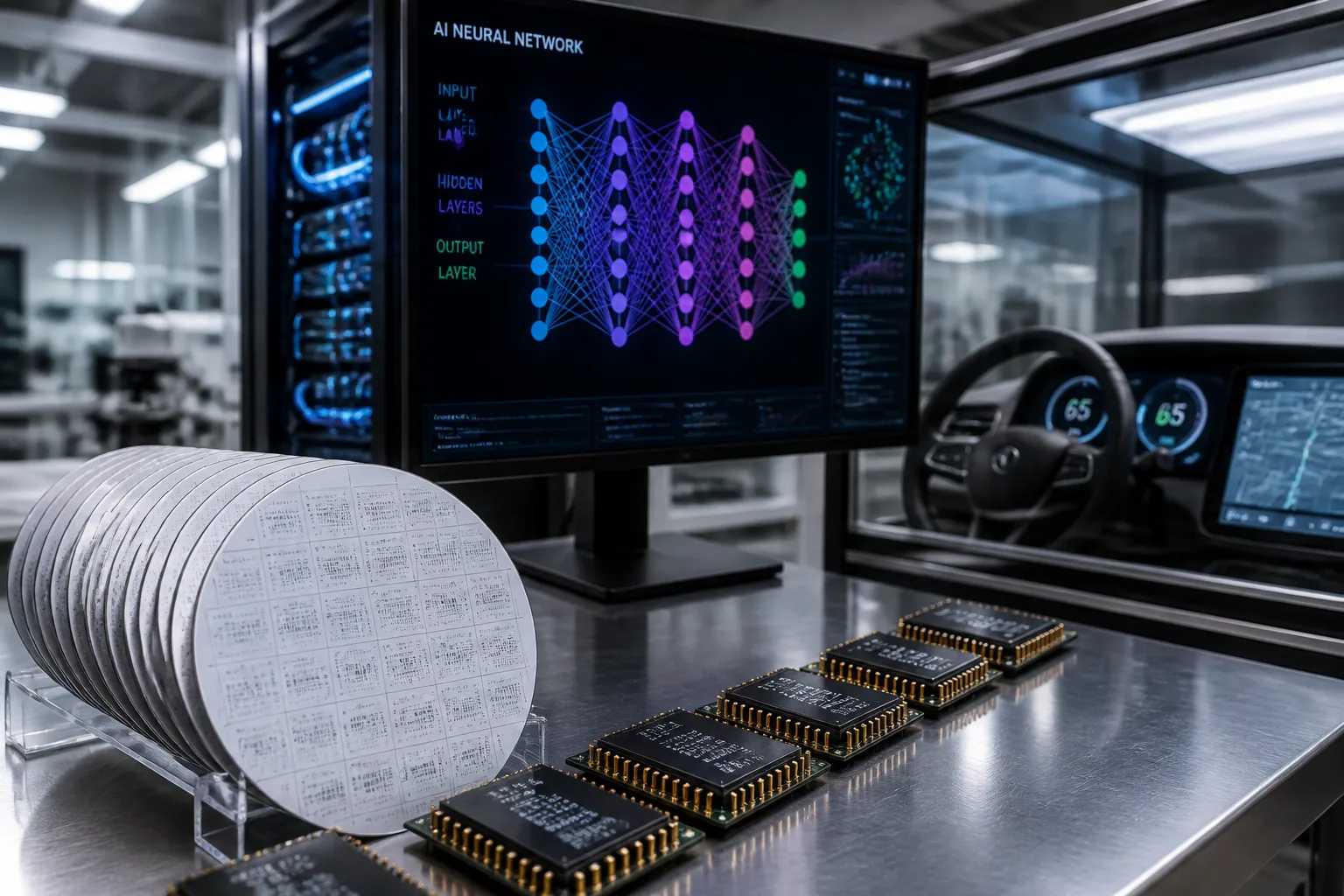
Physical AI differs from digital or generative AI in that it must operate deterministically and meet stringent safety and security standards. NXP’s strategy is to deliver system‑level solutions that integrate compute, analog, sensors, and other technologies into single, reliable packages. The firm is developing a modular AI framework—eIQ Agentic AI—that lets developers tailor AI toolkits and streamline integration.
In the automotive sector, NXP’s radar‑on‑chip family (SAF86xx) supports advanced driver‑assist systems (ADAS) and sits within the company’s broader edge‑AI portfolio. Its automotive edge‑AI technology delivers fast, efficient AI models on in‑car hardware, built on a foundation of safety and security.
Portfolio Realignment
To sharpen its focus on physical AI, NXP is divesting businesses that do not align with this direction. The company is investing in talent, intellectual property, and technologies that fit its roadmap. According to NXP, this realignment will enable more efficient reuse of intellectual property and accelerate execution through AI tools.
Financial Performance
NXP reported a 19 % year‑over‑year revenue increase in the second quarter of 2026, reaching $3.5 billion. Adjusted earnings per share were $3.61, surpassing estimates of $3.50. Shares fell 7.7 % after the earnings announcement.
The company’s 2024 revenue was $12.61 billion, and it employs about 34,000 people in more than 30 countries. NXP’s customers include major technology firms such as Apple, Dell, Ericsson, and Samsung.
Outlook
NXP’s current emphasis is on delivering physical‑AI solutions for automotive and industrial markets while expanding its data‑center revenue. The company plans to continue its asset‑light manufacturing model and accelerate the integration of AI tools across its product lines.
Investors will watch the next earnings report for guidance on the data‑center segment and the progress of the company’s portfolio realignment. Regulatory developments in automotive safety and data‑center energy efficiency may also influence NXP’s trajectory.
In summary, NXP is actively reshaping its business around physical AI, leveraging its strengths in safety and real‑time processing to capture growth in automotive and data‑center markets. The firm’s recent earnings and strategic initiatives suggest a continued emphasis on system‑level solutions and an asset‑light approach to manufacturing.
Speaking at the Goldman Sachs Communacopia + Technology Conference, Sotomayor highlighted the rapid transition from cloud‑centric AI to self‑contained edge solutions. He pointed out that automotive‑related revenue—encompassing software‑defined vehicles, autonomy radar, electrification, and connectivity—represented almost 50 % of NXP’s automotive earnings in Q2 and expanded by over 20 % YoY.
The company also underscored its data‑center segment, forecasting about $500 million in revenue this year versus roughly $200 million in 2025, and projecting a 20 % annual growth rate for 2026.
Physical AI and the Edge
Physical AI differs from digital or generative AI in that it must operate deterministically and meet stringent safety and security standards. NXP’s strategy is to deliver system‑level solutions that integrate compute, analog, sensors, and other technologies into single, reliable packages. The firm is developing a modular AI framework—eIQ Agentic AI—that lets developers tailor AI toolkits and streamline integration.
In the automotive sector, NXP’s radar‑on‑chip family (SAF86xx) supports advanced driver‑assist systems (ADAS) and sits within the company’s broader edge‑AI portfolio. Its automotive edge‑AI technology delivers fast, efficient AI models on in‑car hardware, built on a foundation of safety and security.
Portfolio Realignment
To sharpen its focus on physical AI, NXP is divesting businesses that do not align with this direction. The company is investing in talent, intellectual property, and technologies that fit its roadmap. According to NXP, this realignment will enable more efficient reuse of intellectual property and accelerate execution through AI tools.
Financial Performance
NXP reported a 19 % year‑over‑year revenue increase in the second quarter of 2026, reaching $3.5 billion. Adjusted earnings per share were $3.61, surpassing estimates of $3.50. Shares fell 7.7 % after the earnings announcement.
The company’s 2024 revenue was $12.61 billion, and it employs about 34,000 people in more than 30 countries. NXP’s customers include major technology firms such as Apple, Dell, Ericsson, and Samsung.
Outlook
NXP’s current emphasis is on delivering physical‑AI solutions for automotive and industrial markets while expanding its data‑center revenue. The company plans to continue its asset‑light manufacturing model and accelerate the integration of AI tools across its product lines.
Investors will watch the next earnings report for guidance on the data‑center segment and the progress of the company’s portfolio realignment. Regulatory developments in automotive safety and data‑center energy efficiency may also influence NXP’s trajectory.
In summary, NXP is actively reshaping its business around physical AI, leveraging its strengths in safety and real‑time processing to capture growth in automotive and data‑center markets. The firm’s recent earnings and strategic initiatives suggest a continued emphasis on system‑level solutions and an asset‑light approach to manufacturing.