Blab Business
Bridgestone Holds 2026 Guidance Amid US Demand Weakness and Pricing Pressure
On May 14, 2026, Bridgestone Corporation (BRDCY) reaffirmed its fiscal‑2026 earnings outlook, keeping its EPS forecast at $0.860 despite a sharp contraction in U.S. passenger‑replacement tire demand.
The decision comes after the company reported a 9 % year‑over‑year drop in U.S. passenger‑replacement sales, the steepest decline in its most profitable segment. Bridgestone attributed the slump to a broader slowdown in the U.S. automotive market and to rising raw‑material costs.
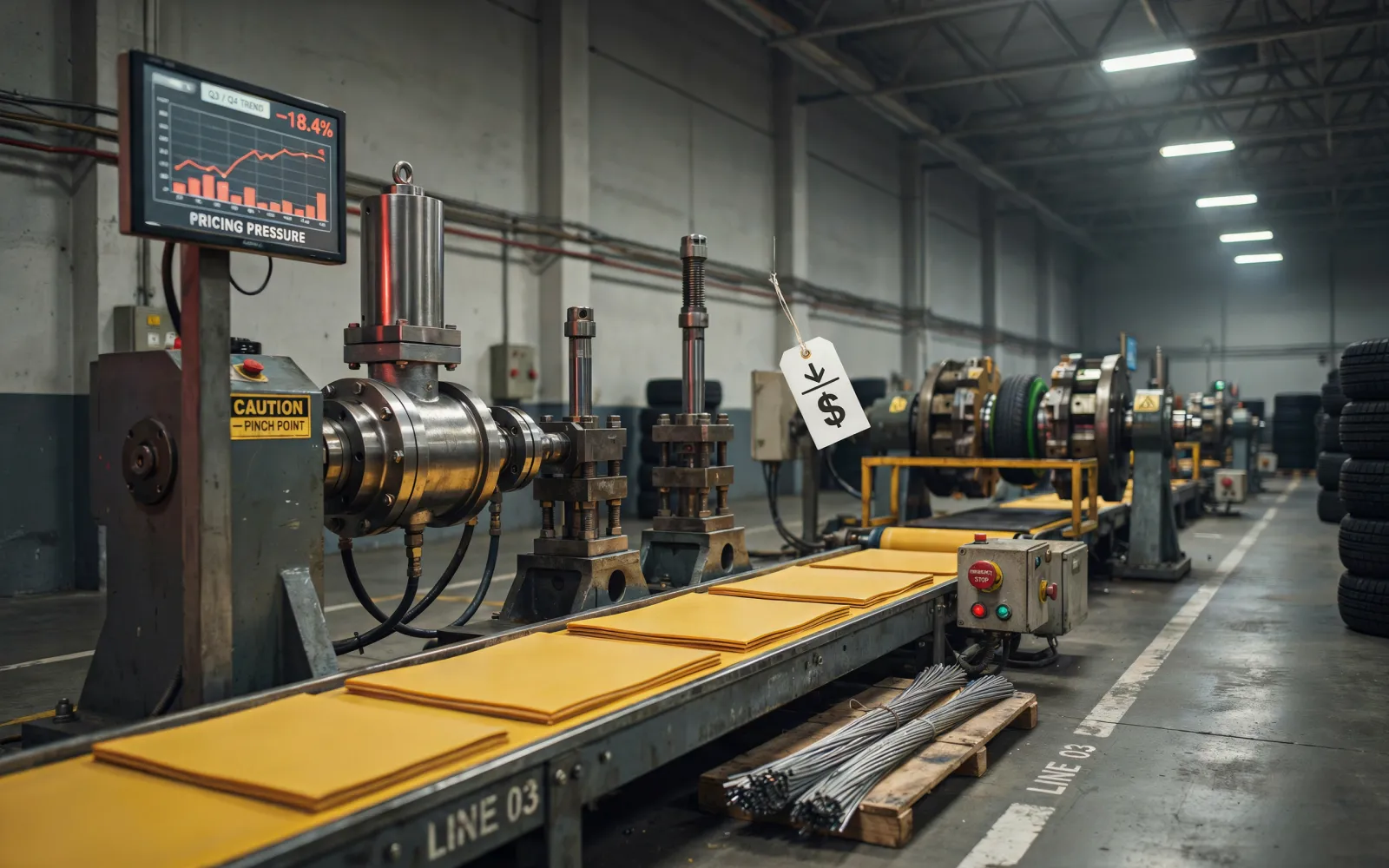
In the same quarter, Bridgestone noted that the contribution from pricing had slowed materially, a sign that competition may be intensifying in selected markets.
Management said that restructuring benefits, productivity gains and stable volume expectations would support the 2026 outlook. The company is in the midst of a global reorganization that split its operations into East and West divisions, a change that began on January 1, 2024. As part of the restructuring, Bridgestone has announced plans to cut roughly 425 jobs over the next six to nine months, according to an industry report.
The company’s investor‑relations page warns that a number of risks and uncertainties could cause actual results to differ materially from those discussed in forward‑looking statements. It highlights that additional U.S. tariffs have affected direct material costs and tire exports to the U.S., and that an economic slowdown in the U.S. has weighed on operating results.
Bridgestone’s valuation remains modest. The stock trades at roughly 12–13 times forward earnings, and it offers a dividend yield close to 4 %. Consensus analysts expect a recovery in operating profit, but the company’s valuation framework indicates limited upside from current levels. As a result, analysts have adopted a neutral stance.
The company is the world’s second‑largest tire manufacturer, a position it has held since 2021. Its global footprint includes 181 production facilities in 24 countries. In the United States, Bridgestone is expanding capacity at its Aiken, South Carolina, and Wilson, North Carolina, plants. The company said that by 2027 it would increase capacity for passenger and light‑truck tires at those sites by 2 million units per year.
The U.S. market remains a key driver for Bridgestone. In 2025, the company described the year as a “year of emergency and crisis management,” citing high raw‑material costs and an apparent economic slowdown in the U.S. The company noted that demand for new truck and bus tires in North America dropped sharply, weighing on exports.
Bridgestone’s FY 2026 guidance of $0.860 EPS is below the consensus estimate of $0.890, according to a market‑beat report. The company’s guidance was issued on the same day as its Q1 2026 earnings call, which was held on May 14. The call’s transcript, available on Yahoo Finance, confirms that the company maintained its guidance and highlighted the impact of pricing and demand softness.
The company’s strategy to maintain guidance amid headwinds is supported by its focus on cost discipline and operational efficiency. Bridgestone has also been working to improve its supply chain resilience after a cyberattack in August 2025 that targeted Bridgestone Americas and caused production backlogs.
In summary, Bridgestone is holding its 2026 outlook in the face of a declining U.S. demand for passenger‑replacement tires, slowing pricing, and macro‑economic challenges. The company’s valuation remains modest, and analysts have taken a neutral stance. Investors will watch the company’s next earnings release, the progress of its restructuring program, and any changes in U.S. demand dynamics.
The next key event for Bridgestone is its upcoming earnings report, scheduled for the end of the fiscal year. The company’s performance will be closely monitored against the backdrop of U.S. tariffs, raw‑material cost pressures, and the broader automotive market recovery.
The decision comes after the company reported a 9 % year‑over‑year drop in U.S. passenger‑replacement sales, the steepest decline in its most profitable segment. Bridgestone attributed the slump to a broader slowdown in the U.S. automotive market and to rising raw‑material costs.
In the same quarter, Bridgestone noted that the contribution from pricing had slowed materially, a sign that competition may be intensifying in selected markets.
Management said that restructuring benefits, productivity gains and stable volume expectations would support the 2026 outlook. The company is in the midst of a global reorganization that split its operations into East and West divisions, a change that began on January 1, 2024. As part of the restructuring, Bridgestone has announced plans to cut roughly 425 jobs over the next six to nine months, according to an industry report.
The company’s investor‑relations page warns that a number of risks and uncertainties could cause actual results to differ materially from those discussed in forward‑looking statements. It highlights that additional U.S. tariffs have affected direct material costs and tire exports to the U.S., and that an economic slowdown in the U.S. has weighed on operating results.
Bridgestone’s valuation remains modest. The stock trades at roughly 12–13 times forward earnings, and it offers a dividend yield close to 4 %. Consensus analysts expect a recovery in operating profit, but the company’s valuation framework indicates limited upside from current levels. As a result, analysts have adopted a neutral stance.
The company is the world’s second‑largest tire manufacturer, a position it has held since 2021. Its global footprint includes 181 production facilities in 24 countries. In the United States, Bridgestone is expanding capacity at its Aiken, South Carolina, and Wilson, North Carolina, plants. The company said that by 2027 it would increase capacity for passenger and light‑truck tires at those sites by 2 million units per year.
The U.S. market remains a key driver for Bridgestone. In 2025, the company described the year as a “year of emergency and crisis management,” citing high raw‑material costs and an apparent economic slowdown in the U.S. The company noted that demand for new truck and bus tires in North America dropped sharply, weighing on exports.
Bridgestone’s FY 2026 guidance of $0.860 EPS is below the consensus estimate of $0.890, according to a market‑beat report. The company’s guidance was issued on the same day as its Q1 2026 earnings call, which was held on May 14. The call’s transcript, available on Yahoo Finance, confirms that the company maintained its guidance and highlighted the impact of pricing and demand softness.
The company’s strategy to maintain guidance amid headwinds is supported by its focus on cost discipline and operational efficiency. Bridgestone has also been working to improve its supply chain resilience after a cyberattack in August 2025 that targeted Bridgestone Americas and caused production backlogs.
In summary, Bridgestone is holding its 2026 outlook in the face of a declining U.S. demand for passenger‑replacement tires, slowing pricing, and macro‑economic challenges. The company’s valuation remains modest, and analysts have taken a neutral stance. Investors will watch the company’s next earnings release, the progress of its restructuring program, and any changes in U.S. demand dynamics.
The next key event for Bridgestone is its upcoming earnings report, scheduled for the end of the fiscal year. The company’s performance will be closely monitored against the backdrop of U.S. tariffs, raw‑material cost pressures, and the broader automotive market recovery.