Blab Business
Singapores Chota House: 17 Years of Hand-Made Slow Fashion and a New International Push
Andrew Tay’s 44‑year‑old boutique on Orchard Road has become a quiet icon of Singapore’s slow‑fashion scene. Founded in 2009, Chota House has spent 17 years producing hand‑crafted garments locally, using mostly Japanese fabrics and traditional techniques such as indigo dyeing and sashiko stitching. The brand’s name—Hindi for “small”—reflects Tay’s focus on meticulous details.
Tay began his career after a year at LASALLE College of the Arts and three years in retail at Saint Laurent. He then worked at the now‑defunct menswear shop Underground in Queensway, where he learned sourcing, design and the day‑to‑day operations of an independent label. When the shop closed, Tay opened Chota House’s first store in Bugis+ (formerly Iluma). Early collections were trend‑driven, but Tay soon shifted to heritage‑inspired pieces that could be produced in small batches.
Unlike many local labels that outsource overseas, Chota House keeps production in Singapore. Tay says the minimum order quantities overseas were too high for a small operation. Local manufacturing gives the brand flexibility: it can adjust patterns, test new fabrics and respond to customer feedback without committing to large runs. The label’s studio in Ubi employs seven freelance craftsmen, and 90 % of its fabrics come from a second‑generation Japanese wholesaler.
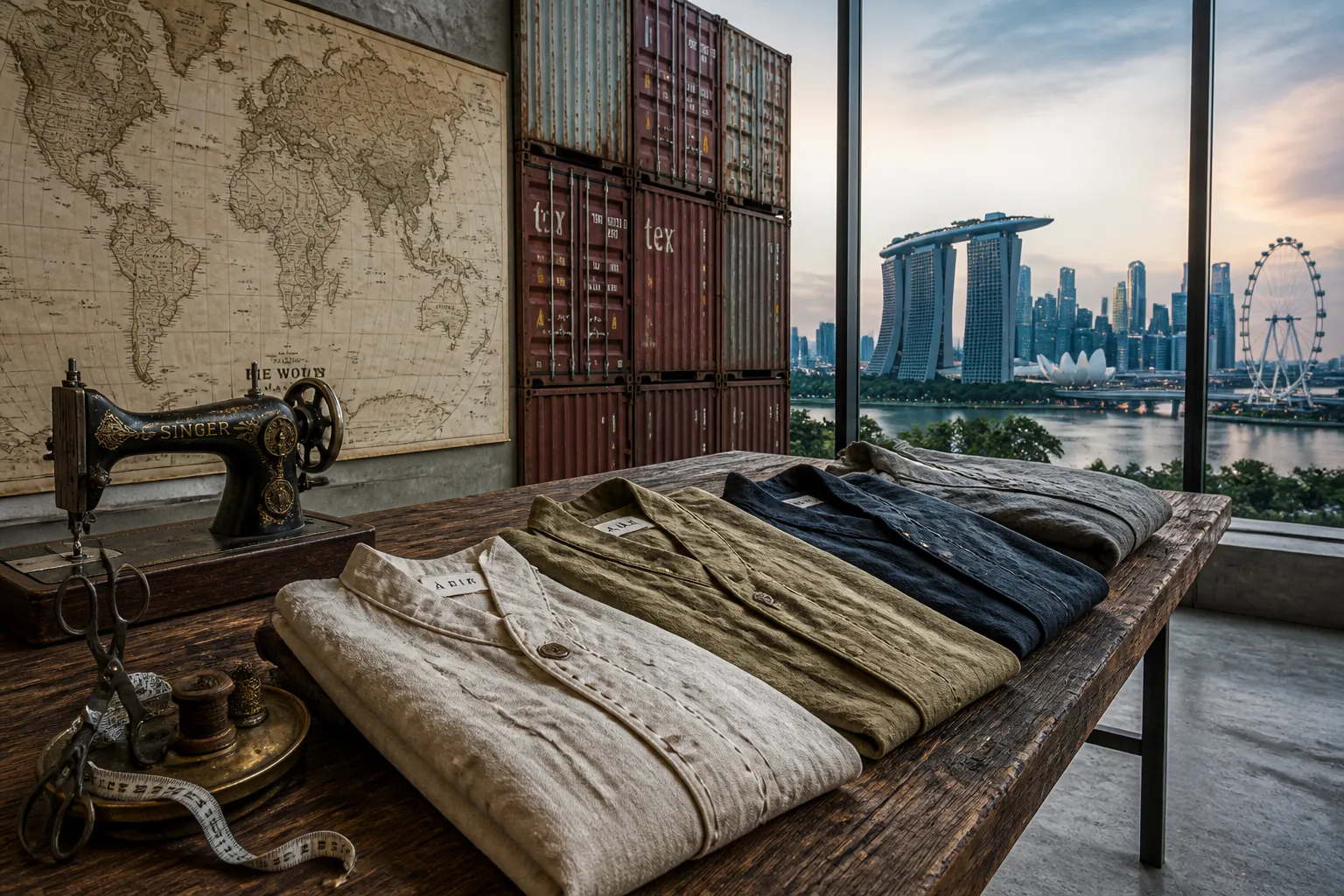
Signature items such as the Gurkha trousers and noragi jackets illustrate the brand’s blend of history and craft. The Gurkha trousers, inspired by 19th‑century Nepalese soldiers, feature a double‑buckle waist for a structured silhouette. Noragi jackets, derived from rural Japanese workwear, retain relaxed proportions and include sashiko stitching and pankou button closures. Chota House also reworks vintage Levi’s jackets: each piece is unstuck by hand, patched, and reconstructed, a process that can take more than a week.
Beyond its own line, Tay has designed uniforms for local businesses. The company produced olive‑hued noragi jackets for the café Waga Waga Den, hard‑wearing Cordura twill coats for barbershop Hounds of the Baskervilles, and a reinterpretation of the classic chore jacket for Singtel. In 2025, Chota House collaborated with Goldheart, dressing models in its denim designs for the jewellery brand’s runway show.
Last year, Chota House was invited by Dors to showcase its collections in Paris during Fashion Week. The label presented its work in Le Marais, accompanied by the French performance collective Tricking Paris. Tay said the event opened his eyes to how his garments were perceived overseas and highlighted that international recognition builds over time rather than through a single sale.
The brand faces pricing and market‑position challenges. Tay notes that customers often compare Chota House’s prices to larger, globally recognised labels and may be reluctant to pay the premium for an independent Singapore brand. Sales have fallen by an estimated 20‑40 % since the start of the year, a decline attributed to rising rents and tighter consumer spending among tourists and locals.
In early 2026, Chota House posted on social media that it was considering closing. The post triggered an overwhelming response: customers, friends and strangers visited the shop daily, and the inbox flooded with messages of support. The outpouring of encouragement helped the label survive a difficult period and reinforced Tay’s commitment to expanding internationally while keeping its Singapore roots.
Today, Chota House continues to produce small‑run, hand‑crafted garments and is planning further international exposure, building on its Paris showcase. The brand remains focused on craftsmanship, slow fashion principles and the story behind each piece.
Tay began his career after a year at LASALLE College of the Arts and three years in retail at Saint Laurent. He then worked at the now‑defunct menswear shop Underground in Queensway, where he learned sourcing, design and the day‑to‑day operations of an independent label. When the shop closed, Tay opened Chota House’s first store in Bugis+ (formerly Iluma). Early collections were trend‑driven, but Tay soon shifted to heritage‑inspired pieces that could be produced in small batches.
Unlike many local labels that outsource overseas, Chota House keeps production in Singapore. Tay says the minimum order quantities overseas were too high for a small operation. Local manufacturing gives the brand flexibility: it can adjust patterns, test new fabrics and respond to customer feedback without committing to large runs. The label’s studio in Ubi employs seven freelance craftsmen, and 90 % of its fabrics come from a second‑generation Japanese wholesaler.
Signature items such as the Gurkha trousers and noragi jackets illustrate the brand’s blend of history and craft. The Gurkha trousers, inspired by 19th‑century Nepalese soldiers, feature a double‑buckle waist for a structured silhouette. Noragi jackets, derived from rural Japanese workwear, retain relaxed proportions and include sashiko stitching and pankou button closures. Chota House also reworks vintage Levi’s jackets: each piece is unstuck by hand, patched, and reconstructed, a process that can take more than a week.
Beyond its own line, Tay has designed uniforms for local businesses. The company produced olive‑hued noragi jackets for the café Waga Waga Den, hard‑wearing Cordura twill coats for barbershop Hounds of the Baskervilles, and a reinterpretation of the classic chore jacket for Singtel. In 2025, Chota House collaborated with Goldheart, dressing models in its denim designs for the jewellery brand’s runway show.
Last year, Chota House was invited by Dors to showcase its collections in Paris during Fashion Week. The label presented its work in Le Marais, accompanied by the French performance collective Tricking Paris. Tay said the event opened his eyes to how his garments were perceived overseas and highlighted that international recognition builds over time rather than through a single sale.
The brand faces pricing and market‑position challenges. Tay notes that customers often compare Chota House’s prices to larger, globally recognised labels and may be reluctant to pay the premium for an independent Singapore brand. Sales have fallen by an estimated 20‑40 % since the start of the year, a decline attributed to rising rents and tighter consumer spending among tourists and locals.
In early 2026, Chota House posted on social media that it was considering closing. The post triggered an overwhelming response: customers, friends and strangers visited the shop daily, and the inbox flooded with messages of support. The outpouring of encouragement helped the label survive a difficult period and reinforced Tay’s commitment to expanding internationally while keeping its Singapore roots.
Today, Chota House continues to produce small‑run, hand‑crafted garments and is planning further international exposure, building on its Paris showcase. The brand remains focused on craftsmanship, slow fashion principles and the story behind each piece.