Blab Business
Indias Nuclear Ambition Hinges on New Financing Rules and Private Risk-Sharing
When the SHANTI Act entered force on 21 December 2025, it finally lifted the government’s monopoly on nuclear construction and introduced liability rules that let private firms build and run reactors. Yet the act’s promise now hinges on a single, stubborn question: who will shoulder the cost overruns that routinely plague large‑scale nuclear projects?
Nuclear plants demand enormous upfront capital, construction spans a decade or more, and supply chains stretch from fuel enrichment to heavy‑forge components and certified welders. History offers stark reminders—Westinghouse’s bankruptcy and the 3.2‑GW Hinkley Point C in the United Kingdom—where overruns, rather than legal liability, eroded balance sheets. In India, the exchequer has traditionally absorbed these overruns, a model that delivered 24 operating reactors but capped deployment at roughly 9 GW over six decades.
Reaching the 100 GW target set for 2047 will require an estimated ₹25 lakh crore. The treasury alone cannot absorb the overruns that may accompany such a scale. Private participation is therefore essential not only for technology and operational expertise but also for additional corporate balance sheets that can share the financial risk.
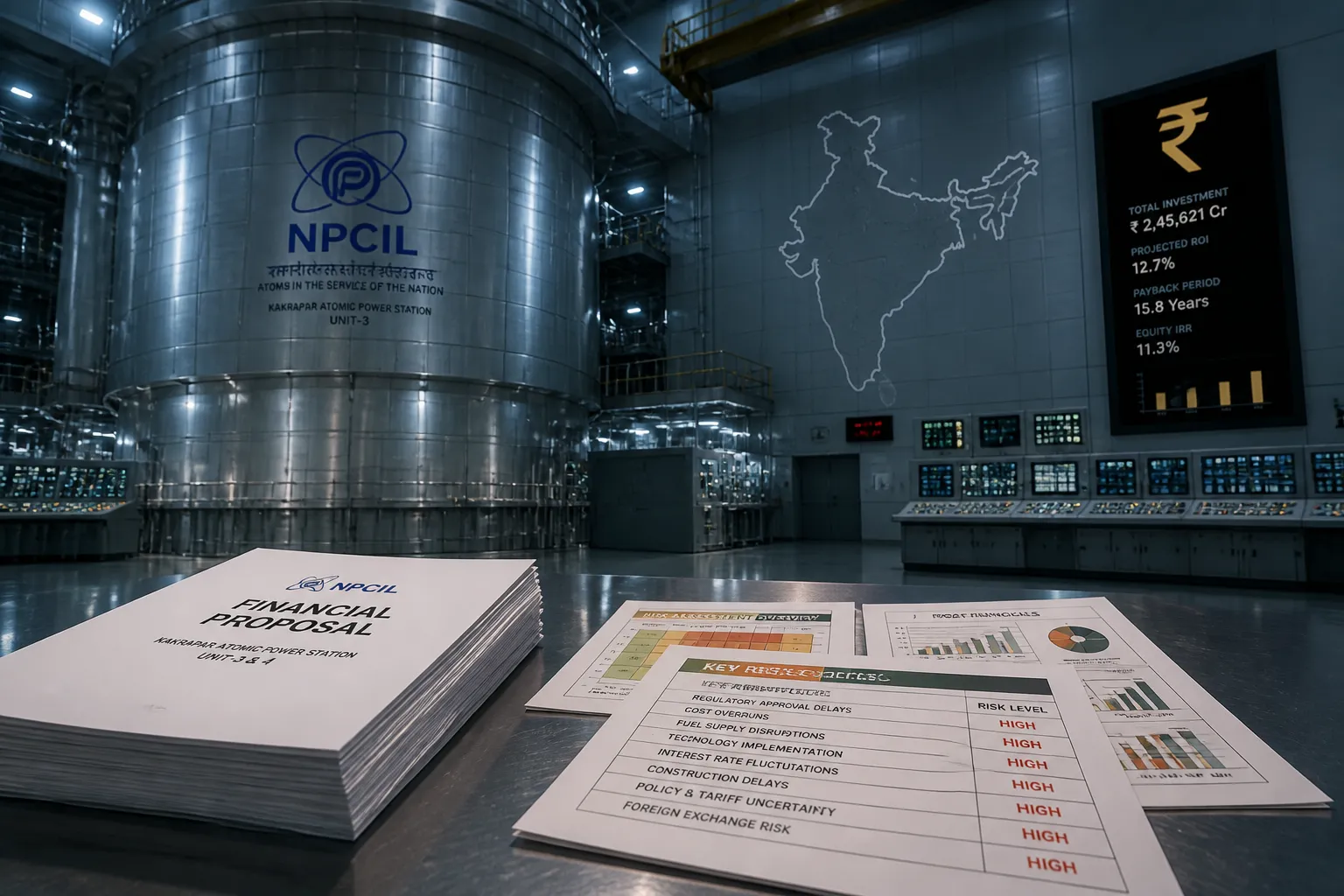
The Bharat Small Reactor (BSR) tender, issued by the Nuclear Power Corporation of India Limited (NPCIL), illustrates the new risk‑allocation model. Private firms are asked to finance and build 220‑MW units under NPCIL’s control and supervision. In this arrangement, the private capital bears the asset risk while the state retains operational control. For lenders, this structure is challenging because project finance relies on step‑in rights; a lender cannot foreclose on a reactor it is not licensed to operate. Consequently, security falls back on the sponsor’s balance sheet with full recourse, limiting the field to a handful of conglomerates that can meet the recourse requirement.
The result is an oligopoly rather than a competitive market, and the residual risk holder has limited influence over the operational decisions that generate the risk. That risk is priced into tariff demands and ultimately lands on distribution companies and consumers.
India’s capital stack is intertwined with technology choices. Three tracks are currently pursued: proven pressurised heavy‑water reactors (PHWRs), indigenous small modular reactors (SMRs) with ₹20 000 crore allocated for five units by 2033, and imported reactors that depend on export‑credit agencies and carry geopolitical exposure. SMRs, which have no operating reference plant, face additional bottlenecks such as high‑assay low‑enriched uranium (HALEU) supply constraints and a global supply chain that prioritises bulk orders.
Financing instruments that are familiar to the nuclear sector—regulated asset base treatment, credit enhancement for distribution companies entering multi‑decade power purchase agreements, and green bond eligibility—are currently unavailable to nuclear projects because India’s sovereign green bond framework explicitly excludes nuclear power. Amending the framework would unlock sustainable global capital.
To attract private investors, the government would need targeted policy support. Viability gap grants could cover initial shortfalls, extended loan terms would ease cash‑flow pressure, preferential tax treatments could improve after‑tax returns, and an official green taxonomy would signal a credible path to sustainability. Temporary cost‑plus tariffs could guarantee fair developer returns and buffer against unexpected cost spikes.
India’s nuclear program boasts strong capabilities across the value chain, from research at the Bhabha Atomic Research Centre to construction and operation by NPCIL. The next phase, however, demands a clear financing strategy that defines the exact risks private investors will absorb and the returns they will demand.
In short, while the SHANTI Act opens the door for private participation, the success of India’s nuclear expansion will depend on how the residual risk is allocated and whether the necessary policy instruments are introduced to make nuclear projects financially viable for private capital.
Nuclear plants demand enormous upfront capital, construction spans a decade or more, and supply chains stretch from fuel enrichment to heavy‑forge components and certified welders. History offers stark reminders—Westinghouse’s bankruptcy and the 3.2‑GW Hinkley Point C in the United Kingdom—where overruns, rather than legal liability, eroded balance sheets. In India, the exchequer has traditionally absorbed these overruns, a model that delivered 24 operating reactors but capped deployment at roughly 9 GW over six decades.
Reaching the 100 GW target set for 2047 will require an estimated ₹25 lakh crore. The treasury alone cannot absorb the overruns that may accompany such a scale. Private participation is therefore essential not only for technology and operational expertise but also for additional corporate balance sheets that can share the financial risk.
The Bharat Small Reactor (BSR) tender, issued by the Nuclear Power Corporation of India Limited (NPCIL), illustrates the new risk‑allocation model. Private firms are asked to finance and build 220‑MW units under NPCIL’s control and supervision. In this arrangement, the private capital bears the asset risk while the state retains operational control. For lenders, this structure is challenging because project finance relies on step‑in rights; a lender cannot foreclose on a reactor it is not licensed to operate. Consequently, security falls back on the sponsor’s balance sheet with full recourse, limiting the field to a handful of conglomerates that can meet the recourse requirement.
The result is an oligopoly rather than a competitive market, and the residual risk holder has limited influence over the operational decisions that generate the risk. That risk is priced into tariff demands and ultimately lands on distribution companies and consumers.
India’s capital stack is intertwined with technology choices. Three tracks are currently pursued: proven pressurised heavy‑water reactors (PHWRs), indigenous small modular reactors (SMRs) with ₹20 000 crore allocated for five units by 2033, and imported reactors that depend on export‑credit agencies and carry geopolitical exposure. SMRs, which have no operating reference plant, face additional bottlenecks such as high‑assay low‑enriched uranium (HALEU) supply constraints and a global supply chain that prioritises bulk orders.
Financing instruments that are familiar to the nuclear sector—regulated asset base treatment, credit enhancement for distribution companies entering multi‑decade power purchase agreements, and green bond eligibility—are currently unavailable to nuclear projects because India’s sovereign green bond framework explicitly excludes nuclear power. Amending the framework would unlock sustainable global capital.
To attract private investors, the government would need targeted policy support. Viability gap grants could cover initial shortfalls, extended loan terms would ease cash‑flow pressure, preferential tax treatments could improve after‑tax returns, and an official green taxonomy would signal a credible path to sustainability. Temporary cost‑plus tariffs could guarantee fair developer returns and buffer against unexpected cost spikes.
India’s nuclear program boasts strong capabilities across the value chain, from research at the Bhabha Atomic Research Centre to construction and operation by NPCIL. The next phase, however, demands a clear financing strategy that defines the exact risks private investors will absorb and the returns they will demand.
In short, while the SHANTI Act opens the door for private participation, the success of India’s nuclear expansion will depend on how the residual risk is allocated and whether the necessary policy instruments are introduced to make nuclear projects financially viable for private capital.